Cinematic rumination and reviews, with a pronounced weakness for Classic Hollywood
Sunday, 26 February 2012
The Glass Key (1935)
Dir.: Frank Tuttle
Plot: Erm... much the same as the more famous 1942 remake. A semi-corrupt politician sparks a gang war, and his trusty lieutenant has to navigate both sides in order to save his boss' career and, increasingly, his own life.
George Raft might not really have been able to act (even at the time, NY Times critic Andre Sennwald remarked that Raft success here was due to his being 'happily cast in a rĂ´le which allows him to be sinister and suave without making excessive demands on his talent') but he could look great just standing around. If you saw nothing but stills of him, you would probably think he was a terrific actor. In what is probably his best role, as ill-fated sidekick Little Boy in the original Scarface (1932), he barely utters more than a few terse lines. And yet the scene in which he first meets Tony's sister, watching her at her window whilst tossing a coin, is one of my favourites in the whole movie. Here, for instance, he has all the thoughtful intensity of Spencer Tracy, but when he opens his mouth, it's the same old Raft.
Tuesday, 10 January 2012
Gunga Din (1939)
Dir: George Stevens
Plot: Three British soldiers and their water-boy encounter intrigue and danger on the trail of mythical gold in imperial India.
It's been said a thousand times, but it bears repeating -1939 was a remarkable year in cinema. It might well be THE year in cinema, at least as far as Hollywood goes. Miracles were wrought in all genres across the board - Garbo laughed, Vivien Leigh's cut-glass vowels went all Southern belle on us, and Thomas Mitchell shrewdly hedged his Oscar bets by adopting various disguises in an apparent attempt to star in every nominated picture of the year (of course, it paid off - out of the 5 Oscar-nominated films he starred in that year, it was his turn in Stagecoach that brought him his personal glory).
Monday, 26 September 2011
Roman Holiday (1953)
Dir.: William Wyler
Plot: A runaway princess falls into the path of an American journalist in Rome. He realises the exclusive on her whereabouts would be the story of a lifetime, but as they spend the day together she starts to seem more than just a meal ticket.
If the plot sounds familiar to you, it’s probably because it’s a very loose reworking of Frank Capra’s 1934 prototype for the genre which became romantic comedy, It Happened One Night. In the two decades that separate the two films, a lot had happened to cinema, and it shows in the European flavour which radiates not only from the gorgeous setting but also from its star.
Friday, 29 July 2011
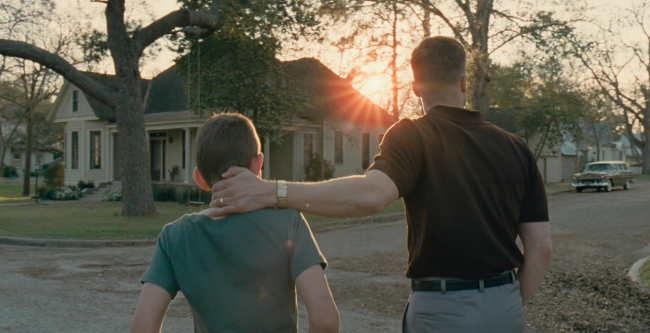
The Tree of Life (2011)
Dir.: Terence Malick
Plot: The death of his brother prompts a middle-aged man to reflect on his conflicted childhood in 1950s Texas
Like the chubby girl who 'doesn't even go here' in Mean Girls, as I approached the local multiplex to see notoriously challenging auteur Terence Malick's divisive Palme d'Or winner, I had a lot of feelings. Chief of which was a decidedly unprofessional last-minute urge to duck into the screen next door and rewatch Deathly Hallows Part 2 -an urge apparently shared by the two people who walked out during the first hour of The Tree of Life, although that was a mild reaction compared to the pockets of rebellious critics who loudly booed the film at its screening in Cannes. Of course, the self-appointed elite vocally professing their disdain for anything that becomes popular enough to win a prize is a long-established tradition at the festival, but nonetheless I was uncertain: what exactly was I about to see? Just what had Malick put on the screen that so aroused the ire of many well-respected critics, including the likes of Mark Kermode, no less?
Friday, 22 July 2011
Harry Potter and the Deathly Hallows, Part 2
Dir.: David Yates
Plot: If you don't know by now, it's kind of a long story.
I just got in from seeing the last Harry Potter film today, so I thought I'd regale you with my first impressions. For context, I've seen all the films and read all the books except the last one (for reasons explained below). Spoilers tossed around like Stupefy spells, so be warned.
Not the best film by far (Azkaban, as though you had to ask), but much less boring than Part 1, whose main protagonist was apparently a forest, given the ratio of trees to actor screentime, Deathly Hallows Part 2 is meatier, pacier and generally far more engaging than its predecessor. It culminates in an extended battle which, wonderful SFX aside, would certainly be too long if it weren't for the weight of the Potterverse underpinning it, the fight for Hogwarts becoming like a battle to hold onto our own Potter-infused childhoods. I have to admit that seeing the castle reduced to chunks of smouldering rubble gave me a funny feeling in my stomach, like watching a tiny fraction of myself disappear. And that's from someone who was never more than a casual fan. This feeling of slow and sometimes painful detachment from the wizarding world is heightened by the absence of so many things we'd come to identify with the series - no Quidditch, no common room scheming, no warm Butterbeer at the Three Bromsticks, no Gryffindor/Slytherin rivalry over the dinner tables. On one hand, this undeniably contributes to the gloomy, uncertain and even cynical tone of the movie; yet it also means the whole magical sensibility of the movie universe feels a little flat in places.
Tuesday, 19 July 2011
The Steel Helmet (1951)
Dir.: Sam Fuller
Plot: In war-ravaged Korea, a ragtag group of US Marines and their orphan mascot try to stay alive whilst holding an important observation post in enemy territory.
I've been waiting to see The Steel Helmet for a long time now, being a fan of Fuller (my display pic is from his whacked-out western Forty Guns), and on the whole I was not disappointed with his characteristically unflinching portrayal of a war which at the time was still in its infancy. Made over ten days in late 1950 with a handful of UCLA students as extras, this is guerilla filmmaking at its rawest; and yet, it managed to make an astonishing $6 million at the box office on a budget of $104,000. Called right-wing fantasy by the left and Communist propaganda by the right, The Steel Helmet was incredibly polarising and hugely influential.
Thursday, 7 July 2011
The Shepherd of the Hills (1941)
Dir.: Henry Hathaway
Plot: The arrival of a stranger in an Ozark mountain village changes the lives of its residents, especially that of a young man out for revenge.
Let me start by saying that I've always got a huge kick out of seeing pre-50s colour films, simply because many wonderful actors were rarely (and sometimes never) shot in colour, and were usually past their prime when they finally got around to it. So it was an especial joy to catch this early John Wayne picture because wow, does the boy look good in Technicolor! He had the most beautiful eyes, and being able to appreciate them in colour changes his whole aspect. He plays second fiddle, however, to the Ozark mountains (or, as is rather more likely, rural California), which fills the screen with resplendent forest scenery for the duration of this utterly bizarre melodrama-cum-parable-cum-Western.
Subscribe to:
Posts (Atom)