Friday, 4 March 2011

Three Came Home (1950)


Dir.: Jean Negulesco
Plot: A colonial official's wife struggles to survive imprisonment in a Japanese POW camp in Borneo.

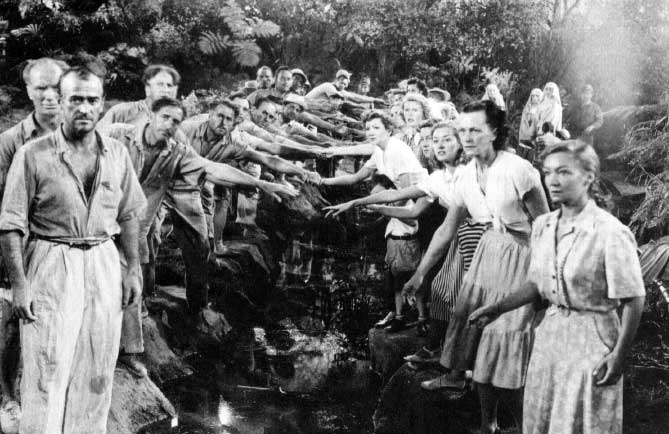
To be honest, I downloaded Three Came Home simply because the story sounded interesting. Empire of the Sun is one of my favourite movies and I do love a good POW drama, especially ones like this that are based on a true story. However, I could not have known that I was about to discover one of my all-time favourite films. So many things about it knocked me for six, but the first and foremost of these has to be Claudette Colbert's lead performance as Agnes Keith.

Sunday, 13 February 2011

True Grit (2010)


Dir.: Joel Coen
Plot: In the post-Civil War West, a fourteen year-old girl and a drunken marshal form an unlikely partnership to find her father's killer.

Well, the folks in Hollywood have finally deigned to release True Grit in the UK, and not a moment too soon - the waiting was killing me. The Coens are my favourite filmmakers of the modern era and seeing a new film of theirs in the cinema is like being able to go back in time and see a Frank Capra or Howard Hawks movie on opening night. Luckily, thanks to some sharp-elbowed maneoeuvring, I managed to bag myself the job of reviewing it for The Oxford Student (editorial privilege) and I thought I'd share it with you here, a whole four days before it will be appearing in print. So, without further ado...

Wednesday, 19 January 2011

SPECIAL: The Thin Man - Lux Radio Theater, 1936


It's been a fair few years now since I first watched The Thin Man, and I dread to think how many times I've watched it since. Twelve would probably be a very conservative estimate... Anyhow, I just got hold of the radio adaptation that aired two years after the film's release, starring most of the original cast, and seeing as I'd never listened to one of these Lux Theater adaptations before, I thought it might be fun to give it a listen. The recording can be found here, thanks to the wonderful Internet Archive.

As you probably know, back in the heyday of radio, way before the arrival of home video, it was very common for actors to reprise their roles for a condensed radio version of a popular recent picture, usually as part of series entitled 'Lux Radio Theater'. The drama would be punctuated (indeed, deflated might be the better word) by occasional plugs for Lux soap ('nine out of ten beautiful screen stars' apparently use it, though I'm somewhat doubtful the evidence for these figures could be produced). In this case, we get a message purportedly from Claudette Colbert read out by a rather dreary male announcer proclaiming her passion for Lux toilet soap. If I thought switching soaps would make me look like Claudette Colbert, I'd be banging on the doors of the warehouse... Anyway, radio may not quite be live theatre but it was certainly pretty challenging, with little time for rehearsal and no retakes (in fact, Powell makes a joke about it afterwards). Quite a few flubbed lines, some awkward pauses (weird, given that I assume they all had scripts in front of them), and some abominably wobbly delivery make this a far less polished affair than the epitome-of-slick movie, but absolutely fascinating nonetheless.

The pair looking down from the relevantly-named Telegraph Hill whilst shooting 'After The Thin Man' the same year.

So how do they all do? How do the cast cope in this different medium? William Powell is as one would expect, charming and witty, although he stumbles over some of his lines and outright flubs one or two (hearing the divine voice falter is really quite surreal). In fact, he doesn't seem quite himself when you can't see his uniquely expressive face, and he sounds almost aware of this. Myrna Loy is an utter pro, never seeming to trip over her words despite the fact that both of them are clearly speaking not only faster than natural but even faster than the mile-a-minute pace of the average 1930s movie, presumably to cram everything into an hour. The only upside of this filletting of the narrative meat is that we lose the movie's dull prologue and start right at the good stuff, ie. the introduction of Nick and Nora. Unfortunately, as mentioned further along, we also lose a lot else, including many of the elements that made the film so special in the first place. Amongst the supporting actors, Porter Hall becomes unintentionally hilarious by recreating his role as Macaulay intonation-for-intonation and emphasis-for-emphasis, leading me at first to suspect that his lines had simply been copy-pasted from the movie. The real surprise is Minna Gombell, whose portrayal of Mimi is the only performance which is as vibrant and lusty on the radio as it was on screen. Amongst a cast which seem a little unsure of themselves, she lights up the production every time she opens her mouth and for this deserves high praise.

One interesting feature of this production is the interludes by the film's director W.S Van Dyke, presumably so that the cast could have a drink and clear their throats. Even if he was the man in charge, 'Woody' Van Dyke seems a bad choice of host - he sounds deeply uncomfortable speaking and at times appears to be struggling with a stammer. His comments consist mostly of highly scripted anecdotes about various Hollywood frolics, which always seem to end by segueing neatly into Lux commercials. I swear, Lux were like soap commercial ninjas...

"Lux... when you least expect it."

To (finally) draw to an end, the most noticeable difference between the two versions is that on radio the story plays like far more of a straight mystery than the delightful comedy that made the film so likeable. Think, for instance, of that lovely facial exchange between the two when Nora walks in on Nick with his arms around Dorothy. Added to which, the severely condensed script cuts out many of the jokes and several of the best scenes (notably the Christmas party, luminous on screen but sadly absent here, as well as completely omitting Nick's being shot by Morelli), and mashes some together with unsatisfying, rushed results - now Nora accompanies Nick to Wynant's shop instead of being packed off to 'Grant's Tomb'.


Just one of the scenes you won't get to hear on tonight's Lux Radio Theater!


Stripped of most of its best elements, the radio production comes off as a down-the-line mystery (complete with crashing orchestral blasts at every mildly dramatic moment), which happens to have a few jokes thrown in as an afterthought. This change in tone doesn't do the material any favours, given that the actual plot still remains incomprehensible, it's just no longer surrounded by all the stuff that made us not care about the plot.  Still, it's great to hear Powell and Loy in this variation on the original, and to hear Powell speak as himself at the end and if nothing else, the radio play is worth a listen for the chance to shudder and thank the Lord someone caught the magic on screen.
Wednesday, 12 January 2011

Holiday (1938)


Dir.: George Cukor
Plot: An adventurous young man travels to meet his fiancee's stuffy, aristocratic family but finds himself becoming increasingly drawn to her free-spirited sister.


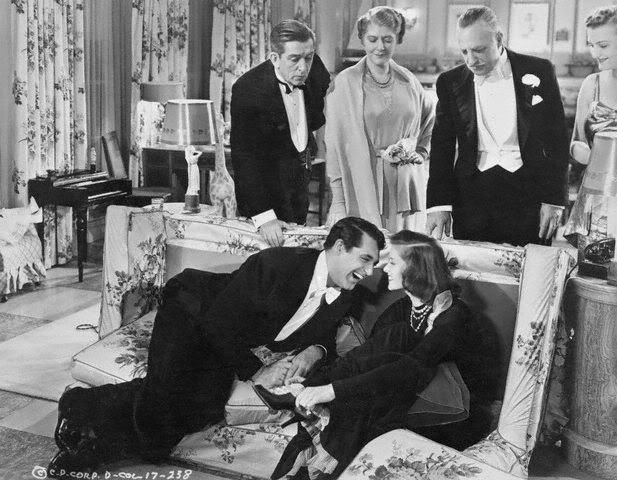
Cary Grant was never as winning, Katharine Hepburn never as fascinating as they both are here, playing two confirmed individuals amongst a flock of wealthy sheep in New York high society. He is Johnny, a poor boy made good, an orphan who put himself through Harvard and is now on the cusp of a successful career, and she is Linda, the eccentric eldest child of a suffocatingly staid family. He arrives at their mansion engaged to her sister Julia, one of those dry, unexciting types that Cary Grant characters always seem to pick first before seeing sense. Upon getting to know her father, Johnny begins to realise that a dull future in business has already been mapped out for him and starts to wonder what he really wants. In the meantime, he strikes up a friendship with Julia's unconventional sister, whose spontaneous nature seems to offer a glimpse of a different kind of life.

Thursday, 23 December 2010

End of Days (1999)


Dir.: Peter Hyams
Plot: Don't be daft...

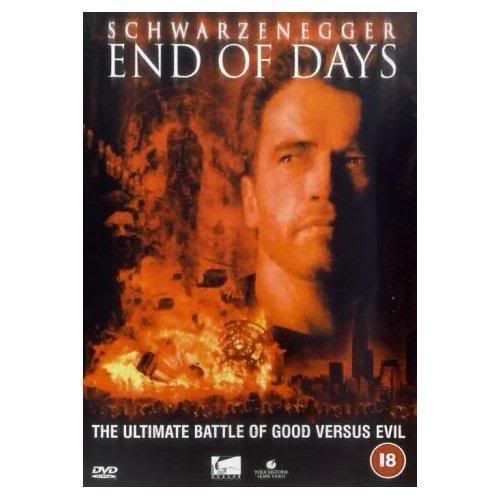
Well, here comes Christmas, and with it one of my absolute favourite holiday turkeys. Near-millenium fever can surely be the only reason this thing ever got made, cashing in as it does on the apocalyptic overtones suggested by approach of the year 2000.

God, this is such a bad film. However, this was my second viewing, so I knew this fact already and yet still taped the damn thing and watched it with my younger brother from start to finish. What I'm getting at, then, is that whilst by all artistic levels (also scientific, religious and general intelligence levels) this is a pisspoor movie, I still enjoy it tremendously. Arnie actually puts in a fairly thoughtful performance at times - okay, his delivery is always going to be stiff, but he manages to produce some tears - as some kind of bereaved cop (I admit I never have paid a huge amount of attention) trying to stop the Devil from impregnating a mortal woman at the moment of the new Millenium, thus establishing his reign over Earth (stick with me here). There are even tears at one particular high-point. Good gravy.

Monday, 6 December 2010

The Intruder, aka. Shame aka. I Hate Your Guts! (1962)


Dir.: Roger Corman
Plot: A small Southern town bubbling with resentment at new racial integration laws boils over after the arrival of a smooth-talking white supremacist who stirs up a frenzy beyond his control.


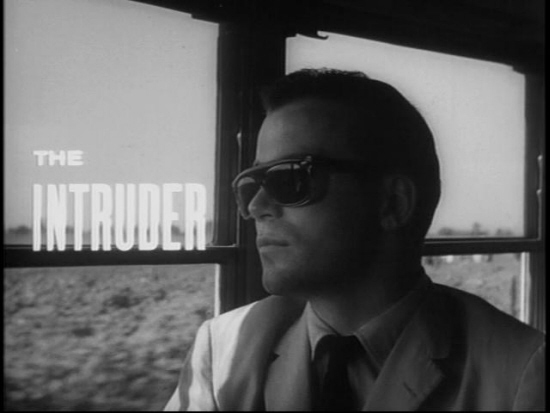
I don’t know if it was the knowingly provocative subject matter, the gaudy re-titlings or the presence of William Shatner that always made me think that this was a schlocky hixploitation picture bashed out to cash in on the Civil Rights movement. I confess I expected to see at least one corrupt overweight sheriff lean back in his desk chair, shoot a mouthful of tobaccy juice into a spittoon and say “Waaall, I’d sure like to help you, boy. But you see, we folks got a way of doin’ things round here…”. However, having now seen the film (albeit a very battered print), I can confirm that Roger Corman’s The Intruder (released several times under different names in a failed attempt to break even) is by no means a trashy race-hate potboiler. On the contrary, it is a very fine, powerful drama with a documentary feel in its raw, ragged glimpses of white Southern anger.

Saturday, 13 November 2010

Home of the Brave (1949)


Dir.: Mark Robson
Plot: An army psychologist tries to help his patient, a mentally unstable black soldier, by digging into the memories of racism and deadly combat which caused him to suffer a breakdown.

One of the lovely things about liking classic cinema is that sometimes you stumble on a significant actor, an actress or even a whole genre you never even knew existed. How many of us, if it weren't for references in Barton Fink and the remake of The Champ, would even be aware of the 'wrestling picture' phenomenon that doubtless made heaps more money than half the artistic dramas we associate with that era? This was one of those moments for me. I knew that the late Forties saw a clash of two films exposing anti-Semitism (the good but rather overrated Crossfire and the appallingly underrated Gentlemen's Agreement), but I never knew that these years, in particular 1949, were notable for a sudden rush of 'tolerance movies' and 'Negro problem pictures'. Coming after Truman's 1948 integration of the armed forces, suddenly black issues were all the rage. Movies like Pinky and Lost Boudaries (both 1949) dealt with the anguish of blacks 'passing', sometimes their whole adult lives, for white. Films began to realise that black people existed as people rather than as porters or maids, and began at last to go some way to answer Myrna Loy's challenge "How about a black person walking up the steps of a court house carrying a briefcase?".