Cinematic rumination and reviews, with a pronounced weakness for Classic Hollywood
Sunday, 21 February 2016
Pat and Mike (1952)
Dir.: George Cukor
Plot: A talented lady golfer with an unusual performance issue falls in with a shrewd sports agent
If you’re the sort of person who hears about Katharine Hepburn’s real-life sporting prowess and immediately says “Oh yeah? I’ll believe it when I see it!” then this is certainly the film for you. Screenwriters Ruth Gordon and Garson Kanin, friends of Hepburn’s, were inspired by her talent for athletics as the basis for her fifth cinematic outing with Tracy.
Monday, 16 September 2013
The Long Voyage Home (1940)
Dir.: John Ford
Plot: A crew of merchant sailors try to stay sane and alive in dangerous waters, while personal catastrophe plagues their ranks.
The Long Voyage Home
may sound like pleasantly forgettable studio fare – a troop of rowdy merchant
sailors played by a familiar array of folksy character actors and a plot
revolving around suspected spies, enemy-infested waters and the occasional mass
brawl. In reality, it strives for a higher plane, thanks to original author
Eugene O’Neill’s poignant examination of the loneliness of the seafaring life
and the inner demons that drive a man to seek such an existence and prevent him
from leaving it.
Friday, 9 August 2013
Yasujiro Ozu Special: The Only Son (1936)/An Autumn Afternoon (1962)
A couple of weeks back, I
was lucky enough to catch a mini Ozu retrospective at the Filmothéque du Quartier Latin, one of Paris’ many terrific little arthouse cinemas in the
district around the Sorbonne. Even better, alongside two of Ozu’s best-known
films - Tokyo Story and An Autumn Afternoon -the management had decided to
include one of the director’s lesser-known works: his first talkie, The Only
Son. Having seen Tokyo Story fairly recently, I skipped it this time round to
focus on the other films in the series, which I was watching for the first
time, and in doing so gained a fresh appreciation of an auteur who only seems
to get better with age. Nonetheless, although one of Ozu’s hallmarks is the
consistency and continuity which links all of his films together, by
juxtaposing his first talking picture and his last we can clearly see that a
journey of tremendous aesthetic and an emotional refinement separates the early
effort and the final masterpiece.
Wednesday, 26 June 2013
Rio Grande (1950)
Dir.: John Ford
Plot: A cavalry officer's dangerous task of protecting settlers from rebellious Apache is made more complicated by the arrival of his estranged wife and son.
Sunday, 30 September 2012
Lawless (2012)
Dir: John Hillcoat
Plot: Three moonshining brothers in 1920s Virginia find their activities disturbed by the arrival of a ruthless lawman determined to wipe them out.
Lawless isn't a very good name for a movie, is it? A bit generic.
A better name for this would be The Beverly Killbillies. Excuse the corny
wordplay, because it serves a higher purpose. Not only does it sum up the plot
of the Nick Cave-penned bootlegging drama, it also sums up its fundamental flaw
- it isn't sure whether it's a bloodsoaked thriller or a good ol' boy yuk-fest
and it never tries probing deep enough to find out.
Tuesday, 18 September 2012
A Tree Grows In Brooklyn (1945)
(This review originally appeared on Kubrick On The Guillotine, a great film site that you should check out)
Dir.: Elia Kazan
Plot: A bright young girl comes of age in a turn-of-the-century Brooklyn tenement, witnessing the tensions and struggles of her family.
Dir.: Elia Kazan
Plot: A bright young girl comes of age in a turn-of-the-century Brooklyn tenement, witnessing the tensions and struggles of her family.
Rarely does a young director’s first feature film contain such striking beauty and power as A Tree Grows in Brooklyn. But then again, rarely is that director Elia Kazan. And the young auteur had hardly set himself an easy task: coming off the back of nothing more than a short film about coal mining in Tennessee, Kazan was to condense an enormously popular 500-page novel by Betty Smith into a 2-hour studio production. The result is an astonishingly assured mini-epic which dampened handkerchiefs across the nation, and launched Kazan into a career that would change American film.
Tuesday, 24 July 2012
The Dark Knight Rises (2012)
Dir.: Christopher Nolan
Plot: A reclusive Bruce Wayne is forced to reassume his alter ego Batman to protect Gotham from a ruthless terrorist with designs on Gotham.
SPOILERS ABOUND
You can’t have your cake and eat it. This is a fundamental
rule of many things in life, and movie making is one of them. The Dark Knight
Rises tries to straddle the line between bleak psychological drama and
extremely fast motorbikes and doesn’t quite manage it. The result is a
frustratingly uneven epic - bolstered with good performances, excellent
direction and some memorable set pieces but ultimately overlong, turgid and weighed
down with questionable subplots and 2D characterisations.
Sunday, 22 July 2012
The Dick Van Dyke Show, Season 2 (1962-3)
The first series of The Dick Van Dyke Show is really good fun, as well as being a textbook example of how to develop rounded, likeable characters. However, this is the season which really gets going, comedically-speaking. It's a mixture of old-fashioned comedy - slapstick, Borscht Belt one-liners, musical interludes - and modern tropes which now make up the staple of sitcoms everywhere. The humour of contemporary domestic tensions, social relationships and suburban pressures was really pushed to the fore for the first time, with smart characters stuck in unavoidable farce yet showing unexpected moments of self-awareness that were previously unseen on television. This season of the show particularly is a fascinating bridge from old to new.
Saturday, 30 June 2012
City For Conquest (1940)
Dir.: Anatole Litvak
Plot: An ex-boxer returns to the ring to support his younger brother and impress his ambitious fiancee, with tragic consequences.
James Cagney didn’t
get too much credit as a serious dramatic actor before his Oscar-winning turn as
George M. Cohan in 1942. City For Conquest is
therefore a rather rare opportunity to see a pre-Yankee Doodle Dandy Cagney
giving it his all in a heady, romantic melodrama which demands very little of
the bantam histrionics which had defined him for much of the 1930s. An uneven,
sudsy affair kept afloat by several strong, affecting performances, it is
possibly most notable for its proto-Manhattan
use of New York
as a romantic metaphor.
Monday, 18 June 2012
Ever In My Heart (1933)
Dir.: Archie Mayo
Plot: A German-American family is torn apart by xenophobia during the First World War, with harrowing consequences.
One of the more unusual early Stanwyck B-pictures, Ever In
My Heart is a breathless 68-minute melodrama with a strong first act, an
excellent second one and an astoundingly dumb third one. But let’s start from the start.
Friday, 8 June 2012
Wild Boys of the Road (1933)
Dir.: William A. Wellman
Plot: Two suburban teenagers run away from home in search of work after their families are hit by the Depression and enter the dangerous world of underage hobos, at the mercy of police, railroad guards and each other.
Eddie (Frankie Darro)
and his friend Tommy (Edwin Phillips) are wisecracking best pals whose
friendship is tested when they decide to run away from home after the
Depression strikes their families. Leaving behind a carefree world of co-ed
dances and jalopy rides they hop a train bound for Chicago and hopes of a job, but soon find
they have become part of a wandering tribe of hundreds. Chased from town to
town by police and attacked by train guards, these teenage outlaws drift from
place to place and anger and desperation soon explode into violent
confrontation.
Thursday, 22 March 2012
Christmas in Connecticut (1945)
Dir.: Peter Godfrey
Plot: A single, city-dwelling journalist is forced to fake the rural domestic bliss she writes about in her lucrative column when her editor and a war veteran invite themselves to her home for Christmas.
Christmas in Connecticut has an excellent premise. Babs Stanwyck plays a Elizabeth Lane, a newspaper columnist famous for her slice-of-life features focussed around her beautiful home, delicious home-cooked food and charming husband and baby. In reality, however, she is a single city gal who lounges around her bohemian apartment whilst her obliging Hungarian neighbour (S.Z Sakall, of whom more later) dreams up the recipes which win her such renown. When a recovering war hero (Dennis Morgan) appeals to the newspaper's editor (Sidmey Greenstreet) for a perfect Christmas holiday with Elizabeth and her family in their country house, things threaten to go off the boil. Enlisting a besotted neighbour (Reginald Gardiner) for help, she sets about creating the grand illusion her columns have painted, but things turn awkward when she starts to fall for the handsome veteran.
Sunday, 26 February 2012
The Glass Key (1935)
Dir.: Frank Tuttle
Plot: Erm... much the same as the more famous 1942 remake. A semi-corrupt politician sparks a gang war, and his trusty lieutenant has to navigate both sides in order to save his boss' career and, increasingly, his own life.
George Raft might not really have been able to act (even at the time, NY Times critic Andre Sennwald remarked that Raft success here was due to his being 'happily cast in a rôle which allows him to be sinister and suave without making excessive demands on his talent') but he could look great just standing around. If you saw nothing but stills of him, you would probably think he was a terrific actor. In what is probably his best role, as ill-fated sidekick Little Boy in the original Scarface (1932), he barely utters more than a few terse lines. And yet the scene in which he first meets Tony's sister, watching her at her window whilst tossing a coin, is one of my favourites in the whole movie. Here, for instance, he has all the thoughtful intensity of Spencer Tracy, but when he opens his mouth, it's the same old Raft.
Tuesday, 10 January 2012
Gunga Din (1939)
Dir: George Stevens
Plot: Three British soldiers and their water-boy encounter intrigue and danger on the trail of mythical gold in imperial India.
It's been said a thousand times, but it bears repeating -1939 was a remarkable year in cinema. It might well be THE year in cinema, at least as far as Hollywood goes. Miracles were wrought in all genres across the board - Garbo laughed, Vivien Leigh's cut-glass vowels went all Southern belle on us, and Thomas Mitchell shrewdly hedged his Oscar bets by adopting various disguises in an apparent attempt to star in every nominated picture of the year (of course, it paid off - out of the 5 Oscar-nominated films he starred in that year, it was his turn in Stagecoach that brought him his personal glory).
Monday, 26 September 2011
Roman Holiday (1953)
Dir.: William Wyler
Plot: A runaway princess falls into the path of an American journalist in Rome. He realises the exclusive on her whereabouts would be the story of a lifetime, but as they spend the day together she starts to seem more than just a meal ticket.
If the plot sounds familiar to you, it’s probably because it’s a very loose reworking of Frank Capra’s 1934 prototype for the genre which became romantic comedy, It Happened One Night. In the two decades that separate the two films, a lot had happened to cinema, and it shows in the European flavour which radiates not only from the gorgeous setting but also from its star.
Friday, 29 July 2011
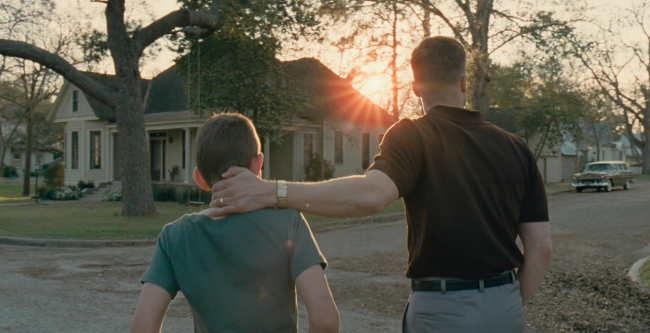
The Tree of Life (2011)
Dir.: Terence Malick
Plot: The death of his brother prompts a middle-aged man to reflect on his conflicted childhood in 1950s Texas
Like the chubby girl who 'doesn't even go here' in Mean Girls, as I approached the local multiplex to see notoriously challenging auteur Terence Malick's divisive Palme d'Or winner, I had a lot of feelings. Chief of which was a decidedly unprofessional last-minute urge to duck into the screen next door and rewatch Deathly Hallows Part 2 -an urge apparently shared by the two people who walked out during the first hour of The Tree of Life, although that was a mild reaction compared to the pockets of rebellious critics who loudly booed the film at its screening in Cannes. Of course, the self-appointed elite vocally professing their disdain for anything that becomes popular enough to win a prize is a long-established tradition at the festival, but nonetheless I was uncertain: what exactly was I about to see? Just what had Malick put on the screen that so aroused the ire of many well-respected critics, including the likes of Mark Kermode, no less?
Friday, 22 July 2011
Harry Potter and the Deathly Hallows, Part 2
Dir.: David Yates
Plot: If you don't know by now, it's kind of a long story.
I just got in from seeing the last Harry Potter film today, so I thought I'd regale you with my first impressions. For context, I've seen all the films and read all the books except the last one (for reasons explained below). Spoilers tossed around like Stupefy spells, so be warned.
Not the best film by far (Azkaban, as though you had to ask), but much less boring than Part 1, whose main protagonist was apparently a forest, given the ratio of trees to actor screentime, Deathly Hallows Part 2 is meatier, pacier and generally far more engaging than its predecessor. It culminates in an extended battle which, wonderful SFX aside, would certainly be too long if it weren't for the weight of the Potterverse underpinning it, the fight for Hogwarts becoming like a battle to hold onto our own Potter-infused childhoods. I have to admit that seeing the castle reduced to chunks of smouldering rubble gave me a funny feeling in my stomach, like watching a tiny fraction of myself disappear. And that's from someone who was never more than a casual fan. This feeling of slow and sometimes painful detachment from the wizarding world is heightened by the absence of so many things we'd come to identify with the series - no Quidditch, no common room scheming, no warm Butterbeer at the Three Bromsticks, no Gryffindor/Slytherin rivalry over the dinner tables. On one hand, this undeniably contributes to the gloomy, uncertain and even cynical tone of the movie; yet it also means the whole magical sensibility of the movie universe feels a little flat in places.
Tuesday, 19 July 2011
The Steel Helmet (1951)
Dir.: Sam Fuller
Plot: In war-ravaged Korea, a ragtag group of US Marines and their orphan mascot try to stay alive whilst holding an important observation post in enemy territory.
I've been waiting to see The Steel Helmet for a long time now, being a fan of Fuller (my display pic is from his whacked-out western Forty Guns), and on the whole I was not disappointed with his characteristically unflinching portrayal of a war which at the time was still in its infancy. Made over ten days in late 1950 with a handful of UCLA students as extras, this is guerilla filmmaking at its rawest; and yet, it managed to make an astonishing $6 million at the box office on a budget of $104,000. Called right-wing fantasy by the left and Communist propaganda by the right, The Steel Helmet was incredibly polarising and hugely influential.
Thursday, 7 July 2011
The Shepherd of the Hills (1941)
Dir.: Henry Hathaway
Plot: The arrival of a stranger in an Ozark mountain village changes the lives of its residents, especially that of a young man out for revenge.
Let me start by saying that I've always got a huge kick out of seeing pre-50s colour films, simply because many wonderful actors were rarely (and sometimes never) shot in colour, and were usually past their prime when they finally got around to it. So it was an especial joy to catch this early John Wayne picture because wow, does the boy look good in Technicolor! He had the most beautiful eyes, and being able to appreciate them in colour changes his whole aspect. He plays second fiddle, however, to the Ozark mountains (or, as is rather more likely, rural California), which fills the screen with resplendent forest scenery for the duration of this utterly bizarre melodrama-cum-parable-cum-Western.
Monday, 27 June 2011
Dan In Real Life (2007)
Dir.: Peter Hedges
Plot: A single father finds love in an unexpected (and awkward) place whilst holidaying with his extended family.
Not feeling particularly great and seeing it was on BBC iPlayer, I sat down to watch this on a whim with fairly meh expectations. In fact, it turned out to be one of the most engaging little movies I've seen all year. Quiet but charming widower Dan (Steve Carell) falls for a woman (Juliette Binoche) who he meets in a bookshop whilst visiting his parents for a big family reunion, but when he gets back to their house, there she is: unfortunately, she happens to be his brother's new girlfriend. Over the next few days, Dan becomes hopelessly infatuated with Marie, something which is increasingly difficult to disguise from his close-knit family.
Subscribe to:
Posts (Atom)